
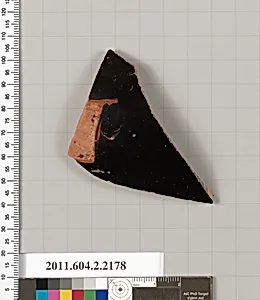
Terracotta fragment of a pot; unglazed on the inside
Unknown Artist
third quarter of the 5th century BCE
Medium
Terracotta
Classification
Vases
Culture & Period
Greek, Attic · Classical
Department
Greek and Roman Art
Museum
Metropolitan Museum of Art, New York, NY
Credit
Gift of Dietrich von Bothmer, Distinguished Research Curator, Greek and Roman Art, 2011
Accession Number
2011.604.2.2178
Rights
Public Domain
Art Historical Context
This terracotta fragment from a pot, dating to the third quarter of the 5th century BCE, offers a glimpse into the everyday artistry of Classical Attic Greece—the golden age of Athens, marked by democratic ideals, philosophical inquiry, and monumental architecture like the Parthenon Produced in Attica, the region around Athens, such vases were ubiquitous in households, symposia, and trade across the Mediterranean, serving practical purposes like storing wine, oil, or water while doubling as canvases for storytelling through painted scenes. Crafted from fired clay and left unglazed on the inside for durability and functionality, this piece exemplifies the technical mastery of Greek potters. By this period, Attic workshops had shifted from black-figure to red-figure techniques, preserving figural details through careful incising and firing. Though only a fragment survives, it reflects the standardized yet skilled production that made Attic pottery a cornerstone of ancient Greek culture, symbolizing both utilitarian craft and aesthetic refinement. Generously gifted to the Metropolitan Museum of Art in 2011 by Dietrich von Bothmer, a pioneering scholar of Greek and Roman art, this artifact enriches our understanding of Classical life. Even in its modesty, it connects us to the vibrant world of ancient Athens, where beauty infused the ordinary.