
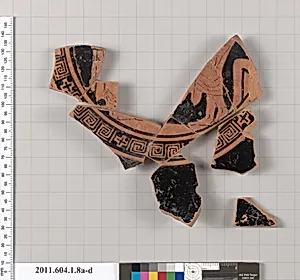
Terracotta fragments of a kylix (drinking cup)
Unknown Artist
mid-5th century BCE
Medium
Terracotta
Classification
Vases
Culture & Period
Greek, Attic · Classical
Department
Greek and Roman Art
Museum
Metropolitan Museum of Art, New York, NY
Credit
Gift of Dietrich von Bothmer, Distinguished Research Curator, Greek and Roman Art, 2011
Accession Number
2011.604.1.8a–d
Rights
Public Domain
Art Historical Context
These terracotta fragments come from a kylix, a shallow two-handled drinking cup popular in ancient Greece during symposia—lively social gatherings where elite men reclined, drank wine, and engaged in intellectual discourse. Dating to the mid-5th century BCE this Attic Greek piece hails from the Classical period a golden age of Athenian art and democracy, when pottery reached extraordinary levels of refinement. Crafted from terracotta, the kylix exemplifies Attic vase-painting techniques, likely featuring the red-figure style where figures were outlined in black slip, leaving the clay's natural red color for details painted in dilute slip. Though fragmented, these shards preserve glimpses of the meticulous artistry that made Athenian pottery a major export, influencing cultures across the Mediterranean. Kylixes often depicted mythological scenes, athletes, or daily life, serving both functional and decorative purposes. Generously gifted to the Metropolitan Museum of Art in 2011 by Dietrich von Bothmer, a renowned curator of Greek and Roman Art, these fragments offer museum visitors a tangible connection to Classical Athens. They remind us how everyday objects embodied the era's ideals of beauty, symmetry, and storytelling.