
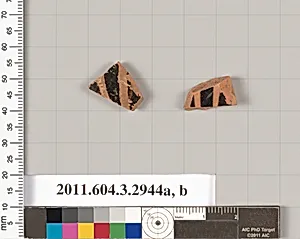
Terracotta fragments of closed shapes
Unknown Artist
late 6th/early 5th century BCE
Medium
Terracotta
Classification
Vases
Culture & Period
Greek, Attic · Archaic
Department
Greek and Roman Art
Museum
Metropolitan Museum of Art, New York, NY
Credit
Gift of Dietrich von Bothmer, Distinguished Research Curator, Greek and Roman Art, 2011
Accession Number
2011.604.3.2944a, b
Rights
Public Domain
Art Historical Context
These terracotta fragments from closed-shape vases offer a glimpse into the vibrant world of Archaic Attic pottery, crafted in ancient Athens during the late 6 to early 5th BCE. Produced in workshops that dominated the Mediterranean trade, these vessels—likely amphorae, jugs, or storage jars—served everyday purposes like holding wine, oil, or water, while also playing roles in rituals and burials. Their survival as shards speaks to the durability of terracotta, fired clay that preserved glimpses of a bustling Greek society on the cusp of the Classical era. Artistically, Attic potters of this period mastered the black-figure technique, incising figures into slip-coated clay before firing to reveal details in reserve against a glossy black ground. Though details on these fragments are limited, they exemplify the precision and narrative flair of Archaic vase-painting, often depicting myths, athletes, or daily life. This transitionary time saw innovations leading to red-figure pottery, revolutionizing Greek art by allowing finer anatomical details. A generous gift to the Metropolitan Museum of Art in 2011 from Dietrich von Bothmer, a pioneering scholar of Greek and Roman art, these pieces enrich our understanding of Athens' cultural output. They remind us how humble fragments connect us to the ingenuity of antiquity. (198 words)