
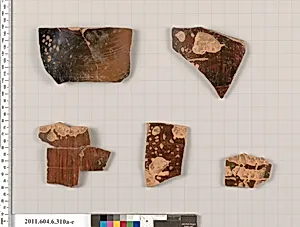
Terracotta fragments of closed shapes
Unknown Artist
6th/5th centuries BCE
Medium
Terracotta
Classification
Vases
Culture & Period
Greek, Attic · Archaic/Classical
Department
Greek and Roman Art
Museum
Metropolitan Museum of Art, New York, NY
Credit
Gift of Dietrich von Bothmer, Distinguished Research Curator, Greek and Roman Art, 2011
Accession Number
2011.604.6.310a–e
Rights
Public Domain
Art Historical Context
These terracotta fragments represent closed-shape vases from Attic Greece, dating to the 6th or 5th century BCE a pivotal transition from the Archaic to Classical periods. Closed shapes, such as jugs or bottles used for storing oils, wines, or perfumes, were everyday essentials in ancient households and trade. Crafted in the renowned Attic workshops near Athens, these pieces exemplify the technical mastery of Greek potters, likely employing black-figure or early red-figure techniques where figures were incised or painted on the fired clay for durability and vivid storytelling. Artistically, Attic vases were more than utilitarian objects—they served as canvases for myths, daily life, and heroic tales, influencing art across the Mediterranean. Though fragmented, these shards offer glimpses into a vibrant culture where pottery was a major export, symbolizing Greece's artistic and economic prowess. The precise decoration and forms highlight the evolution from rigid Archaic poses to the more naturalistic Classical style. Generously gifted in 2011 by Dietrich von Bothmer, the Metropolitan Museum of Art's esteemed curator of Greek and Roman art, these fragments enrich our understanding of ancient craftsmanship. They remind us how even broken pieces preserve the echoes of antiquity's ingenuity.