
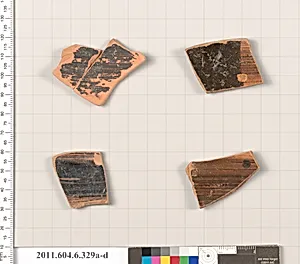
Terracotta fragments of unidentified shapes
Unknown Artist
6th/5th centuries BCE
Medium
Terracotta
Classification
Vases
Culture & Period
Greek, Attic · Archaic/Classical
Department
Greek and Roman Art
Museum
Metropolitan Museum of Art, New York, NY
Credit
Gift of Dietrich von Bothmer, Distinguished Research Curator, Greek and Roman Art, 2011
Accession Number
2011.604.6.329a–d
Rights
Public Domain
Art Historical Context
These enigmatic terracotta fragments, dating to the 6th or 5 century BCE, hail from Attic Greece during the Archaic and Classical periods—a golden age of pottery production in ancient Athens. Classified as vase pieces, they exemplify the skilled craftsmanship of anonymous Attic workshops, where artisans shaped clay on a potter's wheel, decorated it with intricate motifs, and fired it in kilns to achieve durable, reddish-orange terracotta. Though their exact shapes remain unidentified, such fragments often belonged to everyday vessels like amphorae, kraters, or kylikes used for wine, oil, or rituals. Attic vases were more than utilitarian objects; they were cultural ambassadors, exported across the Mediterranean and Black Sea regions, showcasing Greek myths, daily life, and athletic scenes through pioneering techniques like black-figure (incised silhouettes) in the Archaic era and red-figure (reserved clay figures) in the Classical. This generous gift from Dietrich von Bothmer, the Metropolitan Museum of Art's esteemed curator of Greek and Roman Art, in 2011, enriches our understanding of these fragile survivors. Piecing together such shards offers a tantalizing glimpse into the vibrant world of ancient Athens, where art and utility intertwined seamlessly.