
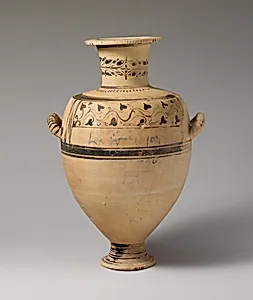
Terracotta Hadra hydria (water jar)
Unknown Artist
227 BCE
Medium
Terracotta
Dimensions
h. 18 in. (45.7 cm); d. 10 7/8 in. (27.6 cm)
Classification
Vases
Culture & Period
Greek, Ptolemaic, Cretan · Hellenistic
Department
Greek and Roman Art
Museum
Metropolitan Museum of Art, New York, NY
Credit
Purchase, 1890
Accession Number
90.9.38
Rights
Public Domain
Art Historical Context
Step into the vibrant world of Hellenistic Greece with this terracotta Hadra hydria a graceful water jar dated precisely to 227 BCE.ed by an unknown artist from the Greek Ptolemaic Cretan culture it stands 18 inches tall and nearly 11 inches wide, embodying the practical elegance of ancient daily life. As a three-handled vessel designed for carrying and pouring water its form reflects the utilitarian beauty of Greek pottery, now housed in the Metropolitan Museum of's Greek and Roman Art Department after its 1890 purchase. Produced during the Hellenistic period (323–31 BCE), this hydria bridges the classical Greek world and the cosmopolitan Ptolemaic dynasty in Egypt, where Cretan workshops supplied vases for elite burials. Named for Alexandria's Hadra necropolis, these jars served as grave markers or memorials, often inscribed with dates—likely how we know this one's exact year. They highlight the era's cultural fusion, blending Aegean craftsmanship with Egyptian funerary customs under Greek rulers like Ptolemy II. Artistically, the terracotta medium showcases Hellenistic potters' skill in molding durable, wheel-thrown forms fired for longevity. Though undecorated details are sparse, its survival underscores the value placed on commemorative objects, offering a poignant glimpse into personal rituals and the interconnected Mediterranean world over 2,200 years ago.