
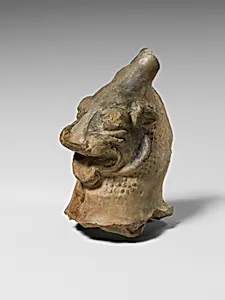
Terracotta head of a griffin
Unknown Artist
4th century BCE
Medium
Terracotta
Dimensions
H. 3 1/8 in. (7.93 cm.) D. 2 7/16 in. (6.19 cm.)
Classification
Terracottas
Culture & Period
East Greek · Late Classical or Early Hellenistic
Department
Greek and Roman Art
Museum
Metropolitan Museum of Art, New York, NY
Credit
Gift of The American Society for the Excavation of Sardis, 1926
Accession Number
26.164.7
Rights
Public Domain
Tags
Art Historical Context
This exquisite terracotta head of ain, crafted by an unknown East Greek artist in the 4th century BCE, the mythical creature's fierce majesty in miniature form. Measuring just over 3 inches high, the griffin—part eagle, part lion—gazes forward with a sharply modeled beak, piercing eyes, and tufted ears, embodying the hybrid beasts revered in ancient lore as vigilant guardians of treasures and divine realms. Hailing from the Late Classical or Early Hellenistic period, this artifact likely originated from Sardis, the Lydian capital in western Anatolia, as evidenced by its excavation history. Terracotta, a versatile fired clay medium, was prized for its affordability and durability, making it ideal for votive offerings, architectural ornaments, or cult statues in sanctuaries. East Greek workshops excelled in such lively, expressive figurines, blending Ionian realism with emerging Hellenistic dynamism. Griffins held profound cultural significance in Greek and Near Eastern mythology, symbolizing strength and protection against evil. Donated to the Metropolitan Museum of Art in 1926, this small yet powerful head invites us to ponder the spiritual devotion of ancient worshippers, bridging the worlds of myth and everyday ritual.