
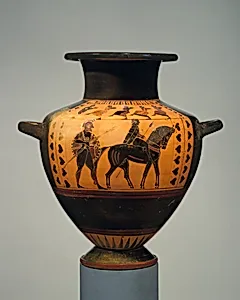
Terracotta hydria (water jar)
ca. 560 BCE
Medium
Terracotta
Dimensions
Overall: 19 3/4 x 15 1/2in. (50.1 x 39.4cm) diameter of mouth 8 1/2in. (21.6cm) diameter of body 12 3/16 in. (30.9 cm)
Classification
Vases
Culture & Period
Greek, Attic · Archaic
Department
Greek and Roman Art
Museum
Metropolitan Museum of Art, New York, NY
Credit
The Bothmer Purchase Fund, 1988
Accession Number
1988.11.3
Rights
Public Domain
Tags
Art Historical Context
This elegant terracotta hydria, or water jar, crafted by renowned Archaic Greek artist Lydos around 560 BCE, exemplifies the pinnacle of Attic black-figure pottery. Standing nearly 20 inches tall with a wide mouth for pouring water, it served a practical purpose in ancient households while showcasing masterful decoration. Lydos, one of the earliest signed Attic vase painters, was prolific in the mid-sixth century BCE, bridging the proto-Attic and mature black-figure styles that dominated Greek ceramics before the shift to red-figure. The vase's surface bursts with life through the black-figure technique: figures are painted in glossy black slip, then incised to reveal the clay beneath for details, with added touches of purple and white for vibrancy. Here, lively scenes of dancing men and women, accompanied by horses, likely evoke a festive komos—a drunken procession tied to Dionysian revelry or symposia celebrations. These motifs highlight the Archaic Greeks' love for rhythm, community, and the equestrian world, blending daily life with mythological flair. Acquired through The Bothmer Purchase Fund in 1988, this hydria from the Metropolitan Museum of Art invites us to glimpse the vibrant artistry of ancient Athens, where pottery was both utility and high art.