
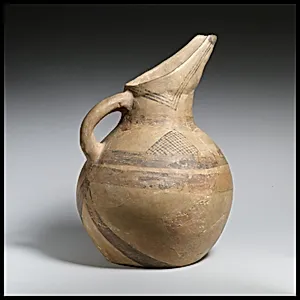
Terracotta jug
Unknown Artist
ca. 2900–2300 BCE
Medium
Terracotta
Dimensions
H. 9 1/8 in. (23.2 cm.)
Classification
Vases
Culture & Period
Minoan · Early Minoan II
Department
Greek and Roman Art
Museum
Metropolitan Museum of Art, New York, NY
Credit
The Cesnola Collection, by exchange, 1911
Accession Number
11.186.1
Rights
Public Domain
Art Historical Context
This unassuming terracotta jug hails from the Early Minoan II period (ca. 2900–2300 BCE), an era marking the formative years of the Minoan civilization on the island of Crete. Standing at just 9 1/8 inches (23.2 cm) tall, it exemplifies the practical pottery produced by this thriving Bronze Age culture, long before the grand palaces of Knossos rose. As part of the Metropolitan Museum of Art's Greek and Roman Art department—reflecting Minoan influences on later Aegean worlds—this vessel offers a window into everyday life on prehistoric Crete. Crafted from terracotta, a fired clay medium ideal for durable storage and transport, the jug highlights early Minoan technological prowess. Potters shaped it by hand, likely on a slow wheel or coiling method, then fired it in kilns to achieve strength for holding liquids like water, oil, or wine. Such vases were essential for households, trade, and rituals, underscoring the Minoans' seafaring economy and agricultural base. Though created by an unknown artist, this jug embodies the unadorned functionality of Early Minoan ceramics, bridging Neolithic traditions and the more elaborate painted wares to come. Acquired through the Cesnola Collection in 1911, it invites us to ponder the ingenuity of Crete's ancient inhabitants, whose innovations laid the groundwork for one of Europe's earliest advanced societies.