
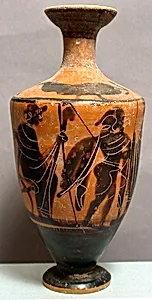
Terracotta lekythos (oil flask)
last quarter of the 6th century BCE
Medium
Terracotta
Dimensions
H. 15.5 cm (6-1/8 in.)
Classification
Vases
Culture
Greek
Department
Greek and Roman Art
Museum
Metropolitan Museum of Art, New York, NY
Credit
Bequest of Nanette B. Kelekian, 2020
Accession Number
2021.40.35
Rights
Public Domain
About this artwork
This small terracotta oil flask represents the continuation of Athenian black-figure pottery traditions into the late 6th century BCE. Like its companion piece also attributed to the Cock Painter, this lekythos demonstrates the specialized production of funerary vessels during the Archaic period. Standing 15.5 centimeters tall, this vessel would have contained precious oils offered to the deceased during burial rituals. The lekythos form, with its narrow neck and single handle, was specifically ...
Art Historical Context
This delicate terracotta lekyth, an ancient Greek oil flask standing just 15.5 cm tall, hails from the last quarter of the6th century BCE. Crafted in Athens during the Archaic period, it a poignant purpose as a funerary vessel, holding precious oils offered to the deceased in burial rituals. Its slender form—with a narrow neck and single handle—was ideal for the controlled pouring of expensive liquids, reflecting the specialized production of these intimate grave goods. Attributed to the Cock Painter, master of black-figure pottery identified through Sir John Beazley's stylistic analysis, this piece showcases exceptional craftsmanship. Artists applied refined clay slip to outline figures and motifs, which fired to a glossy black, while incising fine details through the slip to reveal the red clay beneath. Though the innovative red-figure technique was emerging by this time, conservative funerary lekythoi like this one clung to black-figure traditions, bridging old and new in Athenian workshops. Acquired through the 2020 bequest of Nanette B. Kelekian to the Metropolitan Museum of Art, alongside its companion piece, this lekythos offers a window into ancient Greek rituals and artistry, reminding us of the enduring reverence for the dead.