
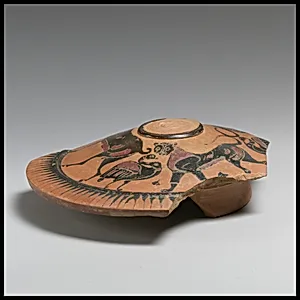
Terracotta lid
mid-6th century BCE
Medium
Terracotta
Dimensions
diameter 5 13/16in. (14.8cm)
Classification
Vases
Culture & Period
Greek, Chalcidian · Archaic
Department
Greek and Roman Art
Museum
Metropolitan Museum of Art, New York, NY
Credit
Purchase, Mrs. Helen H. Mertens Gift, 1978
Accession Number
1978.11.10
Rights
Public Domain
Tags
Art Historical Context
This delicate terracotta lid, crafted by the Group of the Amphora in the mid6th century BCE,ails from the vibrant Chalcidian of Archaic Greece. Produced in workshops near modern-day Rhegion (Reggio Calabria) in southern Italy, Chalcidian vases like this one were highly prized exports, blending Eastern influences with Greek storytelling traditions. The Group's painters were masters of black-figure pottery, a technique where figures were incised into slip before firing, creating sharp contrasts of glossy black against the orange clay. Measuring just 5 13/16 inches in diameter, this lid likely crowned a small vessel for oils, perfumes, or daily use, its compact size belying its artistic ambition. Tags suggest lively motifs of birds and animals—common in Archaic art symbolizing nature's vitality, divine protection, or mythological narratives. Such decorations reflected the Greeks' fascination with the wild world, bridging everyday life and the cosmos. Acquired by the Metropolitan Museum of Art in 1978 through the Mrs. Helen H. Mertens Gift, this piece offers a window into Chalcidian innovation: freer, more dynamic than Attic contemporaries, it influenced later Greek ceramics. For visitors, it evokes the hum of ancient markets where finely potted wares carried stories across the Mediterranean.