
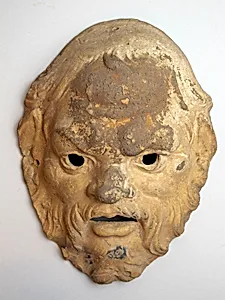
Terracotta mask
Unknown Artist
ca. 100 B.C–50 CE
Medium
Terracotta
Dimensions
Other: 9 1/4 x 7 in. (23.5 x 17.8 cm)
Classification
Terracottas
Culture & Period
Greek or Roman · Late Hellenistic or Early Imperial
Department
Greek and Roman Art
Museum
Metropolitan Museum of Art, New York, NY
Credit
Rogers Fund, 1906
Accession Number
06.1074
Rights
Public Domain
Art Historical Context
This striking terracotta mask, dating to around 100 B.C.–50 C.E., hails from the Late Hellenistic or Early Imperial period reflects the cultural fusion of Greek and Roman artistic traditions. Measuring just 9¼ x 7 inches (23.5 x 17.8 cm), it the portable yet expressive votive objects common in the ancient Mediterranean world. Acquired through the Rogers Fund in 1906, it now resides in the Metropolitan Museum Art's Greek and Roman Department, offering visitors a tangible link to antiquity. Crafted from terracotta—a fired clay favored for its affordability and versatility—the mask likely served ritual, theatrical, or funerary purposes, as these small-scale sculptures were mass-produced using molds for efficiency. This technique allowed widespread dissemination of symbolic imagery, capturing exaggerated features to evoke emotion or divinity. Its survival underscores terracotta's durability in archaeological contexts. In the vibrant crossroads of Hellenistic innovation and Roman expansion, such masks embodied everyday spirituality and performance culture, reminding us how ordinary materials immortalized profound human experiences. A quiet testament to anonymous artistry, it invites contemplation of faces from a bygone era.