
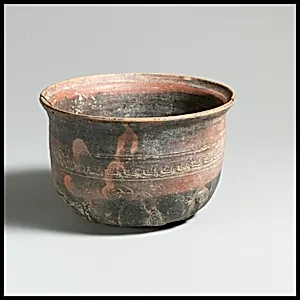
Terracotta Megarian bowl
Unknown Artist
2nd century BCE
Medium
Terracotta
Dimensions
h. 3 1/16 in. (7.8 cm.)
Classification
Vases
Culture & Period
Greek, probably Boeotian · Hellenistic
Department
Greek and Roman Art
Museum
Metropolitan Museum of Art, New York, NY
Credit
Purchase, 1931
Accession Number
31.11.3
Rights
Public Domain
Art Historical Context
Step into the enchanting world of Hellenistic Greece with this delicate *Terracotta Megarian bowl crafted in the 2nd century BCE. Hailing from Boeotia in central Greece, small vessel—standing just 3 1/16 inches (7.8 cm) tall—exemplifies the ingenuity of the Hellenistic period (ca. 323–31 BCE). Following Alexander the Great's conquests, this era saw a burst of artistic experimentation, blending Eastern influences with classical Greek traditions, and everyday objects like this bowl became canvases for refined decoration. Megarian bowls, after the Greek city of Megara (though often made elsewhere, like Boeotia), were revolutionary for their mold-made relief technique. Unlike wheel-thrown pottery, these were pressed into intricate molds, creating detailed, three-dimensional scenes—often mythological or genre subjects—that mimicked luxurious silverware but in affordable terracotta. This innovation allowed wider access to high-style art, reflecting Hellenistic democracy in design and the era's love for elaborate, narrative reliefs. Acquired by the Metropolitan Museum of Art in 1931, this bowl invites us to ponder daily life in ancient Greece: perhaps holding olives or wine at a symposium. Its survival speaks to the enduring appeal of Hellenistic craftsmanship, bridging the gap between elite metalwork and the common hearth.