
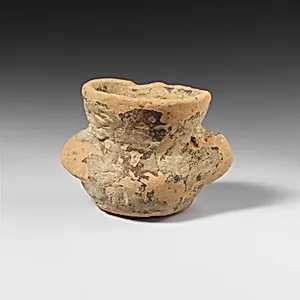
Terracotta miniature vase with rudimentary handles
Unknown Artist
7th–6th century BCE
Medium
Terracotta
Dimensions
H. 1 1/16 in. (2.6 cm)
Classification
Vases
Culture & Period
Greek, Laconian · Archaic
Department
Greek and Roman Art
Museum
Metropolitan Museum of Art, New York, NY
Credit
Gift of A. J. B. Wace, 1924
Accession Number
24.195.191
Rights
Public Domain
Art Historical Context
This delicate terracotta miniature vase, hailing from Laconian Greece in the Archaic period7th–6th BCE), offers a glimpse into the everyday artistry of ancient Sparta's region. Standing just 1 1/16 inches (2.6 cm) tall, its rudimentary handles and simple form mark it as a modest yet charming example of early Greek pottery. Crafted from fired clay, terracotta was a versatile medium prized for its durability and accessibility, allowing potters to produce functional vessels on a small scale. Laconian pottery, produced the rugged Peloponnese, reflects the Archaic era's shift toward more refined shapes and techniques, bridging Geometric abstraction and the emerging black-figure style. Though diminutive, this vase likely served votive or ritual purposes—perhaps as a grave offering or temple dedication—highlighting the Spartans' austere yet devout culture. Its survival underscores the enduring value placed on even the humblest artifacts. A generous gift to the Metropolitan Museum of Art from archaeologist A. J. B. Wace in 1924, this piece invites us to marvel at the skill of anonymous artisans whose tiny creations captured the spirit of a formative age in Western art.