
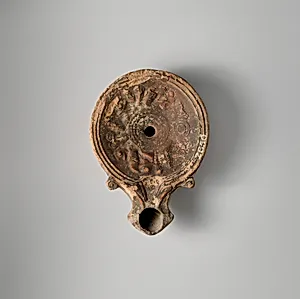
Terracotta oil lamp
Unknown Artist
ca. 20 BCE–25 CE
Medium
Terracotta
Dimensions
Overall: 1 1/4 x 3 5/8 in. (3.2 x 9.2 cm)
Classification
Terracottas
Culture & Period
Roman · Early Imperial
Department
Greek and Roman Art
Museum
Metropolitan Museum of Art, New York, NY
Credit
The Cesnola Collection, Purchased by subscription, 1874–76
Accession Number
74.51.2096
Rights
Public Domain
Tags
Art Historical Context
This delicate terracotta oil lamp, to around 20 BCE–25 CE, hails from the Early Imperial Roman period—a time when Augustus solidified the Roman Empire's foundations after the Republic's turbulent. Measuring just 1¼ x 3⅝ inches, this everyday artifact was likely used to hold olive oil and a wick for illuminating homes, tombs, or public spaces. Terracotta, a fired clay medium, was ideal for mass production via molds, making such lamps affordable and ubiquitous across the empire. What sets this lamp apart is its "Weapons" motif, a tag hinting at decorative elements evoking Roman military might—swords, shields, or spears perhaps rendered in relief. These symbols underscored Rome's martial identity during an era of expansion and conquest, blending utility with cultural pride. Artisans skillfully pressed wet clay into two-part molds, bisque-fired it for durability, then glazed or burnished details for a subtle sheen. Part of the Metropolitan Museum of Art's Cesnola Collection (acquired 1874–76), this unassuming piece offers a window into Roman domestic life, where even lighting evoked imperial power. Imagine it flickering in a modest villa, casting shadows on frescoed walls—a testament to the era's ingenuity and worldview.