
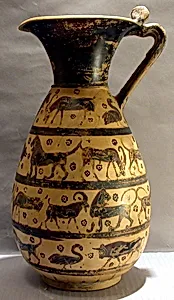
Terracotta olpe
3rd quarter 7th century BCE
Medium
Terracotta, pigment
Dimensions
H. 36 cm x D. 19.5 cm (across top)
Classification
Vases
Culture & Period
Greek · Early Corinthian
Department
Greek and Roman Art
Museum
Metropolitan Museum of Art, New York, NY
Credit
Bequest of Nanette B. Kelekian, 2020
Accession Number
2021.40.4
Rights
Public Domain
About this artwork
"Terracotta olpe" by Attributed to Master of Vatican, 73, created in 3rd quarter 7th century BCE, is executed in terracotta, pigment. This vases belongs to the Metropolitan Museum's Greek and Roman Art collection. The work measures h. 36 cm x d. 19.5 cm (across top). It originates from Greek, Early Corinthian. The artwork entered the museum's collection through bequest of nanette b. kelekian, 2020.
Art Historical Context
This elegant terracotta olpe, to the Master of Vatican73, hails from Greece's Early Corinthian period the third quarter of the 7th century. Standing 36 cm tall with a 19.5 cm mouth diameter, this jug-like vessel—ideal for pouring wine or oil—exemplifies Corinth's dominance in pottery production during the Archaic era. Now part of the Metropolitan Museum of Art's Greek and collection through the 2020 bequest of Nanette B. Kian, it showcases the period's innovative use of terracotta fired with pigment slips, laying groundwork for the black-figure technique. Corinthian vases like this olpe were prized for their miniaturist precision and lively motifs, often featuring friezes of animals, mythical creatures, or komast dancers inspired by Eastern influences. The Master's hand is recognized by scholars for its distinctive linear style and incised details, bridging Proto-Corinthian exuberance with the more refined Orientalizing trends. These vessels weren't just functional; they served as status symbols in symposia and sanctuaries, reflecting Corinth's thriving trade networks across the Mediterranean. As a snapshot of early Greek artistry, this olpe invites us to imagine bustling workshops where potters and painters collaborated to capture the vibrancy of the ancient world. Its survival offers rare insight into a pivotal moment when Greek pottery began influencing broader artistic traditions.