
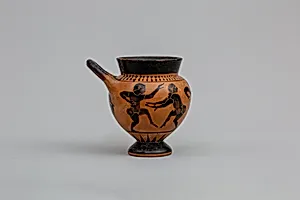
Terracotta one-handled drinking cup
3rd quarter of the 6th century BCE
Medium
Terracotta
Dimensions
H. 3 13/16 in. (9.7 cm) diameter 3 1/4 in. (8.2 cm)
Classification
Vases
Culture & Period
Greek, Chalcidian · Archaic
Department
Greek and Roman Art
Museum
Metropolitan Museum of Art, New York, NY
Credit
Purchase, Mr. and Mrs. Robert E. Hecht Jr. Gift, 1981
Accession Number
1981.11.4
Rights
Public Domain
Tags
Art Historical Context
This delicate terracotta one-handled cup, crafted by the Inscription Painter the 3rd quarter the 6th century, hails from the Chalcidian workshops of ancient Greece during the Archaic period. just under 4 inches tall with a 3¼-inch diameter, it's a compact vessel perfectly suited for intimate symposia—lively gatherings where Greek men shared wine, stories, and song. Chalcidian pottery, produced near the island of Euboea, was renowned for its export across the Mediterranean, blending Attic influences with local flair in black-figure technique, where figures were painted in glossy black slip and details incised to reveal the clay beneath. The cup's decoration captures men in dynamic dance, a joyful motif evoking the revelry of komos processions that followed feasts. Named for his frequent use of inscriptions—often playful or dedicatory—the Inscription Painter brought vivid energy to these scenes, highlighting the Archaic era's celebration of male camaraderie and physicality. Such vases weren't just functional; they were storytelling canvases, reflecting the cultural centrality of wine-drinking rituals in Greek society. Acquired by the Metropolitan Museum of Art in 1981 through a generous gift, this piece offers a window into everyday luxury of the ancient world, where even a simple cup pulsed with life and rhythm.