
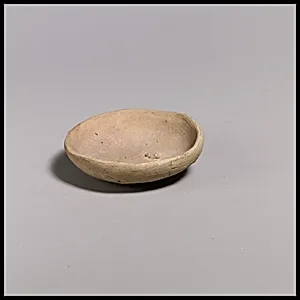
Terracotta saucer
Unknown Artist
ca. 2650–2150 BCE
Medium
Terracotta
Dimensions
H. 3/4 in. (1.9 cm.) Diameter 2 1/2 in. (6.3 cm.)
Classification
Vases
Culture & Period
Helladic · Early Helladic II
Department
Greek and Roman Art
Museum
Metropolitan Museum of Art, New York, NY
Credit
Gift of the Greek Government, 1927
Accession Number
27.120.17
Rights
Public Domain
Tags
Art Historical Context
This delicate terracotta saucer, to the Early Helladic II periodca. 2650–2150 BCE), offers a glimpse into the daily life of prehistoric communities on mainland Greece. Measuring just 3/4 inch high and 2 1/2 inches in diameter this petite vessel from the Helladic culture—part of the Aegean Bronze Age likely used for serving food, liquids, or perhaps small offerings. Its simple, functional form reflects the practical pottery traditions of early settled farming villages, where such items were essential household wares. Crafted from terracotta, a fired clay medium prized for its durability and accessibility, the saucer exemplifies the technical advancements in ceramic production during this era. Potters shaped these vessels by hand or on early wheels, firing them in open kilns to achieve a sturdy, reddish body. Though unadorned, its survival underscores the resilience of everyday objects, providing archaeologists with key evidence of Helladic society’s material culture, trade, and domestic rituals before the rise of later Minoan and Mycenaean civilizations. Now housed in the Metropolitan Museum of Art’s Greek and Roman Art Department as a 1927 gift from the Greek Government, this unassuming saucer invites us to ponder the lives of its anonymous makers—farmers and artisans whose modest creations laid the foundation for Greece’s enduring artistic legacy.