
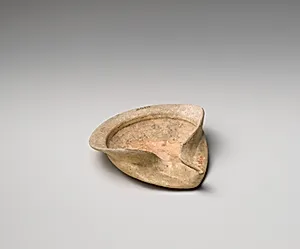
Terracotta saucer-shaped oil lamp
Unknown Artist
5th century BCE
Medium
Terracotta
Dimensions
Length: 5 1/16 in. (12.9 cm) Height: 1 1/2 in. (3.8 cm)
Classification
Terracottas
Culture & Period
Cypriot · Cypro-Classical
Department
Greek and Roman Art
Museum
Metropolitan Museum of Art, New York, NY
Credit
The Cesnola Collection, Purchased by subscription, 1874–76
Accession Number
74.51.1989
Rights
Public Domain
Art Historical Context
This delicate terracotta saucer-shaped oil lamp hails from 5th-century BCE Cyprus, during the Cypro-Classical period (ca. 475–323 BCE), a time when the island bridged Eastern and Greek influences. Crafted by an unknown artisan, its modest dimensions—5 1/16 inches long and 1 1/2 inches high—belie its role as an essential household item. Filled with olive oil and a wick, such lamps illuminated daily life, from humble homes to sanctuaries, reflecting Cyprus's vibrant pottery tradition. Terracotta, fired clay abundant on the resource-rich island, allowed for simple wheel-throwing or molding techniques, producing durable, functional forms like this shallow saucer with a spout for the flame. The unadorned design emphasizes practicality over decoration, yet it exemplifies Cypriot terracottas' subtle elegance—smooth surfaces and precise shaping that ensured steady burning. These lamps were ubiquitous, underscoring the period's blend of utility and subtle artistry amid cultural exchanges with Greece and the Near East. Now part of the Metropolitan Museum of Art's renowned Cesnola Collection, acquired through public subscription in 1874–76, this piece offers a tangible glimpse into ancient Cypriot ingenuity. Visitors can appreciate how everyday objects like this preserved light—and history—for generations.