
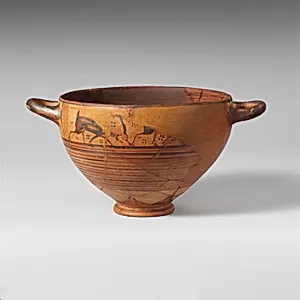
Terracotta skyphos (deep drinking cup)
Unknown Artist
ca. 600 BCE
Medium
Terracotta
Dimensions
H. 3 3/4 in. (9.5 cm) diameter 5 3/8 in. (13.7 cm)
Classification
Vases
Culture & Period
East Greek · Archaic
Department
Greek and Roman Art
Museum
Metropolitan Museum of Art, New York, NY
Credit
Gift of The American Society for the Exploration of Sardis, 1916
Accession Number
16.75.12
Rights
Public Domain
Tags
Art Historical Context
This delicate terracotta skyphos or deep drinking cup, hails from East Greek culture around 600 BCE, during theic period—a vibrant era when Greek pottery blossomed with lively animal motifs and refined forms. Standing just 3¾ inches tall with a 5⅜-inch diameter, its compact size made it ideal for everyday use or symposia, the social drinking gatherings central to ancient Greek life. Crafted from fired clay, a durable and versatile medium, it exemplifies the technical prowess of East Greek potters, who often adorned such vessels with friezes of deer, evoking the wild beauty of the natural world. The deer's presence in the decoration underscores the Archaic fascination with fauna, symbolizing grace, speed, and perhaps mythological ties to Artemis, goddess of the hunt. East Greek wares, produced in regions like Samos or Rhodes, stood out for their bold, incised designs and glossy slips, bridging geometric rigidity and the coming classical realism. Discovered through excavations linked to Sardis—an ancient Lydian hub with Greek influences—this skyphos offers a window into cross-cultural exchanges in the Aegean world. A generous gift to the Metropolitan Museum of Art in 1916 from the American Society for the Exploration of Sardis, it invites us to sip from the past, imagining hands that once raised it in toast to friendship and revelry.