
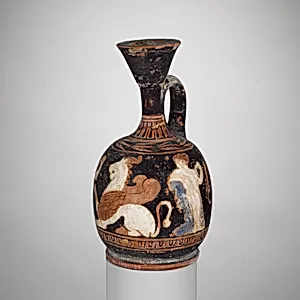
Terracotta squat lekythos (oil jar)
Unknown Artist
early 4th century BCE
Medium
Terracotta
Dimensions
H. 5 1/4 in. (13.3 cm)
Classification
Vases
Culture & Period
Greek, Attic · Classical
Department
Greek and Roman Art
Museum
Metropolitan Museum of Art, New York, NY
Credit
Rogers Fund, 1906
Accession Number
06.1021.199
Rights
Public Domain
Tags
Art Historical Context
This charming terracotta squat lekyos, or oil jar, hails from Attic Greece in the early 4th century BCE during the Classical period. just 5¼ inches (13.3 cm) tall, these compact vessels were essential for storing scented oils and ointments, often used in rituals or funerary offerings. Produced in Athens, the heart of Greek pottery innovation, this piece exemplifies the refined craftsmanship of Attic workshops, where potters shaped clay on a wheel and fired it to a warm reddish hue. Adorned with scenes featuring women and mythical griffins—fierce creatures with eagle heads and lion bodies—the vase likely served a symbolic purpose. Griffins, revered as guardians of treasures in Greek mythology, often appeared in art to evoke protection or the divine. The white-ground technique, common for squat lekythoi of this era, would have provided a luminous backdrop for delicate figures painted in outline and dilute colors, heightening their ethereal quality. Such motifs reflected Classical ideals of beauty, mythology, and the afterlife. Acquired through the Rogers Fund in 1906, this vase now graces the Metropolitan Museum of Art's Greek and Roman Art collection, offering a window into ancient Athenian life and beliefs. Its petite scale belies its cultural weight, bridging the mundane and the mystical in everyday Greek society.