
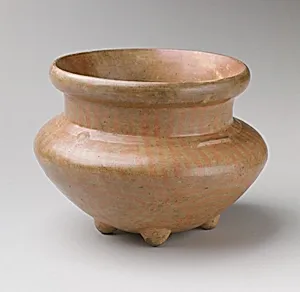
Tetrapod Jar
Unknown Artist
200 BCE–1 CE
Medium
Ceramic
Dimensions
H. 5 1/2 in. (14 cm)
Classification
Ceramics-Containers
Culture
Maya
Department
Arts of Africa, Oceania, and the Americas
Museum
Metropolitan Museum of Art, New York, NY
Credit
Gift of Arthur M. Bullowa, 1982
Accession Number
1982.207.5
Rights
Public Domain
Art Historical Context
Behold the delicate **Tetrapod Jar**, a captivating ceramic vessel from the ancient Maya culture, crafted between 200 BCE and 1 CE during the Late Preclassic period. Standing just 5½ inches (14 cm) tall, this small container exemplifies the ingenuity of early Mesoamerican potters. Its distinctive tetrapod form—supported by four sturdy legs—elevates it both literally and figuratively, a design that allowed it to rest stably while perhaps symbolizing connections to the earth's supports in Maya cosmology. As a ceramic container, this jar highlights the Maya mastery of clay working, likely fired in open pits or early kilns to achieve its enduring form. Ceramics were central to Maya life, serving practical purposes like storage or serving while doubling as ritual objects in burials and ceremonies. The unknown artist's anonymous skill speaks to a vibrant tradition where form and function intertwined, reflecting a society on the cusp of monumental achievements like early pyramids and writing systems. Today, generously gifted by Arthur M. Bullowa in 1982, this jar graces the Metropolitan Museum of Art's Arts of Africa, Oceania, and the Americas department. It invites us to ponder the daily rhythms and spiritual depths of the Maya world, a testament to artistry that has survived millennia.