
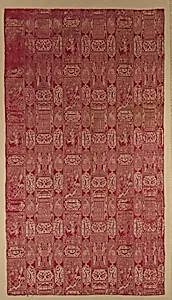
Textile Depicting a Scene from Nizama's Khamsa
Unknown Artist
16th–17th century
Medium
Silk, metal wrapped thread; double-weave
Dimensions
Textile: L. 25 3/4 in. (65.4 cm) W. 14 3/8 in. (36.5 cm) Mount: H. 29 1/2 in. (74.9 cm) W. 18 in. (45.7 cm) D. 2 1/4 in. (5.7 cm) Wt. 8 lbs. (3.6 kg)
Classification
Textiles-Woven
Department
Islamic Art
Museum
Metropolitan Museum of Art, New York, NY
Credit
Fletcher Fund, 1946
Accession Number
46.156.7
Rights
Public Domain
Tags
Art Historical Context
This exquisite textile, woven in the 16th–17th century, captures a vibrant scene from Nizami Ganjavi's *Khamsa*, a collection of five epic Persian poems from the 12th century. Popular in Islamic art, the *Khamsa* inspired countless illustrations across manuscripts, paintings, and textiles blending romance, adventure, and moral tales. Here, an unknown artist deftly rendered human figures, horses, and animals in a dynamic composition, evoking the grandeur of Persian storytelling traditions during the Safavid era or similar cultural hubs. Crafted from silk with metal-wrapped threads using the sophisticated double-weave technique, the piece measures about 25¾ by 14⅜ inches. Double-weave allowed weavers to create two interconnected layers simultaneously—often reversible and richly detailed—mimicking the intricacy of miniature paintings on fabric. The shimmering metallic threads catch the light, enhancing the luxurious appeal typical of elite Islamic textiles used as wall hangings, saddle covers, or ceremonial objects. Housed in the Metropolitan Museum of Art's Islamic Art department (acquired via the Fletcher Fund in 1946), this artwork highlights the technical mastery and cultural prestige of Persian weaving. It transports visitors to a world where poetry and craft intertwined, celebrating human and equine forms in harmonious splendor.