
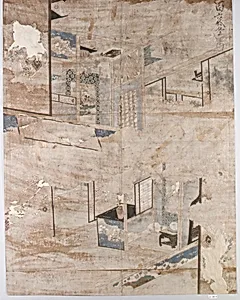
Textile Design for Stencil
Unknown Artist
17th century
Medium
Paint on paper
Dimensions
23 1/2 x 18 1/4 in. (59.69 x 46.35 cm)
Classification
Textiles-Methods and Materials
Culture
Japan
Department
Asian Art
Museum
Metropolitan Museum of Art, New York, NY
Credit
Rogers Fund, 1920
Accession Number
20.98.9
Rights
Public Domain
Tags
Art Historical Context
This delicate 17th-century Japanese design for a stencil, on paper, offers a glimpse into the artistry Edo-period craft traditions. Measuring 23½ x 18¼ inches, it features floral motifs—a hallmark of Japanese decorative arts—likely intended as a template for katazome, a sophisticated resist-dyeing technique. Artisans would cut intricate patterns into thick mulberry paper stencils, then apply rice-paste resist through them onto fabric, allowing dyes to create vibrant, repeatable designs on kimonos and other garments. The unknown artist's work highlights the precision and ingenuity of Japan's textile industry during a time of cultural flourishing and urban sophistication. Flowers symbolized beauty, transience, and harmony with nature in Japanese aesthetics, making this stencil a practical yet poetic tool for mass-producing elegant textiles. Acquired through the Rogers Fund in 1920, it now resides in the Metropolitan Museum of Art's Asian Art Department, exemplifying methods and materials that bridged art and everyday life. Such designs underscore Japan's innovative blend of functionality and refinement, inviting us to appreciate the hidden mastery behind sumptuous fabrics.