
Textile Fragment
Unknown Artist
4th–6th century
Medium
Camelid hair
Dimensions
Overall: 13 x 32 1/2 in. (33.02 x 82.55 cm) Other: 13 in. (33.02 cm)
Classification
Textiles-Woven
Culture
Recuay
Department
Arts of Africa, Oceania, and the Americas
Museum
Metropolitan Museum of Art, New York, NY
Credit
Gift of George D. Pratt, 1930
Accession Number
30.16.7
Rights
Public Domain
Tags
Art Historical Context
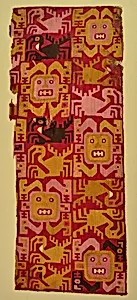
This exquisite Textile Fragment hails from the Recuay culture of ancient Peru, dating to the 4th–6th century CE Woven from camelid hair—likely from llamas or alpacas, animals central to Andean life—this 13 x 32½-inch piece exemplifies the sophisticated textile traditions of the north-central Peruvian highlands. The Recuay people, who thrived from around 200 BCE to 600 CE, produced textiles not just for clothing but as symbols of status, ritual, and cultural identity, often rivaling their renowned ceramics in complexity. The fragment's motifs, featuring stylized birds and faces, reflect Recuay artistic hallmarks. Birds, symbolizing deities or supernatural forces, and bold anthropomorphic faces evoke a vibrant cosmology blending human, animal, and mythical realms. Crafted through intricate weaving techniques, such as complementary warp weaving, these designs demonstrate the weavers' mastery in creating dense, durable fabrics that preserved cultural narratives for generations. A generous gift to the Metropolitan Museum of Art in 1930 by George D. Pratt, this survivor offers a rare glimpse into pre-Inca artistry, highlighting how textiles served as portable canvases for storytelling in the ancient Andes.