
Textile Fragment
Unknown Artist
4th–5th century
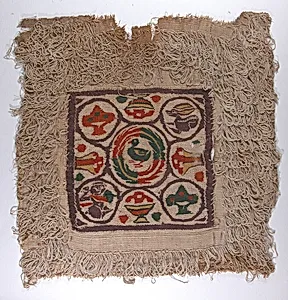
Medium
Wool, linen; plain weave, tapestry weave, weft loop weave
Dimensions
Textile: L. 18 5/8 in. (47.3 cm) W. 18 1/2 in. (47 cm) Mount: L. 19 1/2 in. (49.5 cm) W. 19 1/2 in. (49.5 cm)
Classification
Textiles-Tapestries
Department
Islamic Art
Museum
Metropolitan Museum of Art, New York, NY
Credit
Purchase by subscription, 1889
Accession Number
89.18.21
Rights
Public Domain
Tags
Art Historical Context
This exquisite Textile Fragment, dating to the 4th–5th century, offers a glimpse into the sophisticated world of late antique weaving from the Islamic world. Housed in the Metropolitan Museum Art's Department of Islamic Art, this wool and linen piece—measuring about 18½ by 18⅝ inches—was acquired through a subscription purchase in 1889 Though the artist remains unknown, its classification as a tapestry highlights the era's mastery of textiles, which were prized for clothing, furnishings, and trade across the Mediterranean and Near East. Crafted using a combination of plain weave for the sturdy foundation, tapestry weave for vibrant, discontinuous patterns, and weft loop weave for textured effects, the fragment showcases innovative techniques that allowed for intricate designs. Motifs like ducks—evident from its tags—likely drew from nature-inspired themes common in early textiles, reflecting everyday life or symbolic abundance in agrarian societies. As a survivor from over 1,500 years ago, this fragment underscores the cultural and economic significance of textiles in pre-Islamic regions that shaped later Islamic art. Its preservation reveals the enduring artistry of anonymous weavers, bridging ancient craftsmanship with the luxurious traditions of Islamic decorative arts.