
Textile Fragment
Unknown Artist
3rd–4th century
Medium
Wool, linen; plain weave, tapestry weave
Dimensions
H. 25 7/8 in. (65.7 cm) W. 2 5/8 in. (6.6 cm)
Classification
Textiles
Department
Islamic Art
Museum
Metropolitan Museum of Art, New York, NY
Credit
Purchase by subscription, 1889
Accession Number
89.18.48
Rights
Public Domain
Art Historical Context
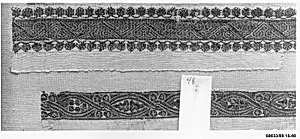
This delicate *Textile Fragment*, dating to the 3rd–4th century, offers a glimpse into the sophisticated textile traditions of Late Antiquity in regions associated with early Islamic culture, such as Egypt or the Near East. Housed in the Metropolitan Museum Art's Department of Islamic Art, this narrow strip—measuring 25⅞ inches high by just 2⅝ inches wide—was acquired through a subscription purchase in 188. Likely part of a larger garment, curtain, or burial shroud, exemplifies the everyday artistry of anonymous weavers whose work adorned both the living and the dead. Crafted from wool and linen using plain weave for the ground and tapestry weave for decorative elements, the fragment highlights advanced techniques that allowed for vibrant, pictorial designs. Plain weave provided a sturdy tabby foundation, while tapestry weave—employing discontinuous wefts—enabled bold motifs without wasting precious yarn, a hallmark of efficiency in ancient production. These methods, rooted in millennia-old practices, influenced later Islamic textiles renowned for their geometric and figural splendor. Though the artist remains unknown, this fragment's survival underscores the cultural reverence for textiles in pre-Islamic societies transitioning into the Islamic era. It invites us to marvel at the skilled hands behind these enduring threads, preserving stories of daily life across centuries.