
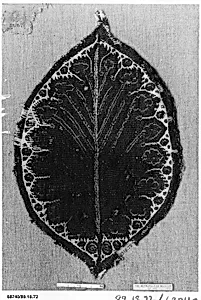
Textile Fragment
Unknown Artist
3rd–4th century
Medium
Wool, linen; plain weave, tapestry weave
Dimensions
H. 11 5/8 in. (29.5 cm) W. 7 1/16 in. (18 cm)
Classification
Textiles
Department
Islamic Art
Museum
Metropolitan Museum of Art, New York, NY
Credit
Purchase by subscription, 1889
Accession Number
89.18.72
Rights
Public Domain
Art Historical Context
This delicate *Textile Fragment*, dating to the 3rd–4th century, offers a window into the sophisticated world of early textile production in the regions associated with Islamic art traditions. Crafted from wool linen, it measures just 11⅝ × 7¹/₁₆ inches (29.5 × 18 cm), yet exemplifies the durability and artistry of ancient weaving. Housed in the Metropolitan Museum Art's Islamic Art department its purchase by subscription in 1889 it survives as a testament to everyday craftsmanship from late antiquity. The fragment employs a combination of plain weave—a simple, balanced interlacing of warp and weft for structural strength—and tapestry weave, where discontinuous wefts create vibrant, image-rich surfaces. Tapestry technique, in particular, was prized for its ability to depict motifs like figures or geometric patterns, often used in garments, furnishings, or ceremonial cloths. This labor-intensive method underscores the weavers' expertise, blending functionality with decorative flair. As a rare survivor from over 1,600 years ago, this piece highlights textiles' cultural role in early societies, from personal adornment to trade goods. In the broader narrative of Islamic art, it bridges pre-Islamic techniques with the opulent fabric traditions that later defined the Islamic world, inviting us to appreciate the unsung heroes behind these colorful threads.