
Textile Fragment
Unknown Artist
3rd–4th century
Medium
Wool, linen; plain weave, tapestry weave
Dimensions
H. 27 9/16 in. (70 cm) W. 17 11/16 in. (45 cm)
Classification
Textiles
Department
Islamic Art
Museum
Metropolitan Museum of Art, New York, NY
Credit
Purchase by subscription, 1889
Accession Number
89.18.74
Rights
Public Domain
Tags
Art Historical Context
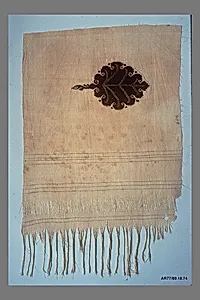
This exquisite *Textile Fragment* from the 3rd–4th offers a glimpse into the sophisticated textile arts of Late Antiquity, likely originating from the Near East or Egypt. Crafted from wool and linen, it measures an impressive 27 9/16 × 17 11/16 inches (70 × 45 cm), making it a substantial surviving piece despite its fragmentary state. Acquired by the Metropolitan Museum of in 1889 through a subscription purchase, it resides in the Islamic Art department highlighting the continuity of weaving traditions that bridged pre-Islamic and later Islamic cultures. The fabric employs a combination of plain weave—a sturdy, foundational technique for everyday durability—and tapestry weave, where colorful weft threads are woven discontinuously to create vivid, pictorial designs. This labor-intensive method allowed artisans to depict motifs like leaves, evoking the natural world and symbolizing growth, abundance, or paradise gardens common in ancient decorative arts. Such patterns were not merely ornamental but carried cultural resonance, adorning garments, furnishings, or ceremonial objects in daily life. As an anonymous masterpiece, this fragment underscores the anonymous skill of ancient weavers, whose techniques influenced Byzantine, Coptic, and early Islamic textiles. Visitors can appreciate how these vibrant leaves capture the era's blend of utility and artistry, preserved for over 1,600 years.