
Textile Fragment
Unknown Artist
3rd–4th century
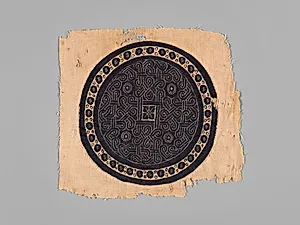
Medium
Wool, linen; plain weave, tapestry weave
Dimensions
H. 12 5/8 in. (32 cm) W. 13 3/8 in. (34 cm)
Classification
Textiles
Department
Islamic Art
Museum
Metropolitan Museum of Art, New York, NY
Credit
Purchase by subscription, 1889
Accession Number
89.18.85
Rights
Public Domain
Art Historical Context
This delicate *Textile Fragment* from 3rd–4th century offers a glimpse into the sophisticated traditions of the Late Antique period, preserved in the Metropolitan Museum of's Department of Islamic Art. Craft from wool and linen—staple fibers of the ancient Near East and Egypt—the piece measures 12⅝ × 13⅜ inches (32 × 34 cm). Acquired through a subscription purchase in 1889 it exemplifies early museum efforts to collect artifacts that illuminate pre-Islamic craftsmanship bridging Roman, Byzantine, and emerging Islamic cultures. The fragment employs a plain weave (tabby) for its sturdy ground cloth, overlaid with tapestry weave, a labor-intensive technique where colored weft yarns are woven directly into motifs without floating threads. This method, prized for its durability and vibrant patterns, was ideal for garments, hangings, or upholstery in daily life. Such textiles highlight the technical prowess of anonymous artisans, whose work survived the ravages of time thanks to Egypt's arid tombs and refuse heaps. As a rare survivor from over 1,600 years ago, this fragment underscores the cultural and economic importance of textiles in ancient trade networks, from the Nile Valley to the Silk Roads. It invites us to appreciate the artistry of the everyday, where wool's warmth met linen's breathability in creations that adorned bodies and homes alike.