
Textile Fragment
Unknown Artist
5th–6th century
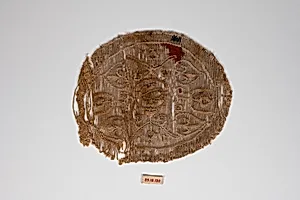
Medium
Wool, linen; plain weave, tapestry weave
Dimensions
H. 6 5/16 in. (16 cm) W. 5 1/2 in. (14 cm)
Classification
Textiles
Department
Islamic Art
Museum
Metropolitan Museum of Art, New York, NY
Credit
Purchase by subscription, 1889
Accession Number
89.18.130
Rights
Public Domain
Art Historical Context
This delicate *Textile Fragment* from the 5th–6th century offers a glimpse into the sophisticated textile traditions of the early medieval Near East, a period bridging Late Antiquity and the dawn of Islamic culture. Crafted from wool and linen in a compact 6 5/16 × 5 1/2 inches (16 × 14 cm), it originated from regions like Egypt or Syria, where such fragments were common in garments, furnishings, or burial wrappings. Acquired by subscription in 1889 for the Metropolitan Museum of Art Islamic Art department, it exemplifies the enduring allure of these ancient survivals. The fragment showcases two key weaving techniques: a plain weave for the sturdy ground fabric, providing a simple over-under structure ideal for everyday durability, and tapestry weave for decorative patterns. In tapestry weave, colored wefts are inserted discontinuously to form motifs without floats on the reverse, a labor-intensive method that allowed vibrant designs in limited spaces. This combination highlights the technical prowess of anonymous artisans, whose work influenced later Islamic textiles. Culturally, such fragments reveal the centrality of textiles in trade, status, and ritual during a transformative era of cultural exchange between Byzantine, Sassanian, and emerging Islamic worlds. Though small, this piece whispers stories of skilled hands and vibrant markets, inviting us to appreciate the fragility of history preserved in thread.