
Textile Fragment
Unknown Artist
3rd–4th century
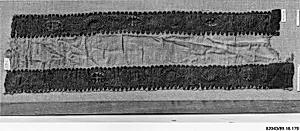
Medium
Wool, linen; plain weave, tapestry weave
Dimensions
Max. H. 6 in. (15.2 cm) Max. W. 23 1/2 in.(59.7 cm)
Classification
Textiles
Department
Islamic Art
Museum
Metropolitan Museum of Art, New York, NY
Credit
Purchase by subscription, 1889
Accession Number
89.18.170
Rights
Public Domain
Art Historical Context
This exquisite *Textile Fragment* from the 3rd–4th offers a glimpse into the daily artistry of late antiquity. Crafted from wool and linen using plain weave for the ground and tapestry weave for motifs, it measures just 6 inches high by 23½ inches wide—likely a surviving piece from a larger garment, curtain, or furnishing. Acquired by the Metropolitan Museum of Art 1889 through public subscription, it resides in the Islamic Art department highlighting textiles from regions that bridged ancient and emerging Islamic cultures, such as Egypt or the Near East. The weaving techniques showcase remarkable skill: plain weave provided a sturdy, flexible base, while tapestry weave allowed artisans to create intricate, colorful patterns by interweaving dyed yarns. This method, labor-intensive yet durable, was prized for its ability to depict figurative scenes or geometric designs, reflecting both technical mastery and aesthetic refinement. Culturally, such fragments reveal the vibrancy of pre-Islamic textile production, where wool and linen were everyday staples for clothing and household goods. They underscore the continuity of craft traditions into the Islamic era, emphasizing textiles' role in personal expression and trade across the ancient world. A testament to anonymous creators, this piece invites us to appreciate the enduring beauty of functional art.