
Textile Fragment
Unknown Artist
3rd–4th century
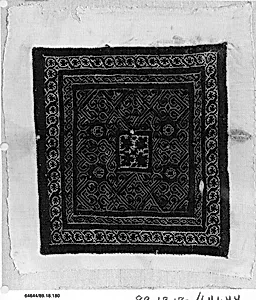
Medium
Wool, linen; plain weave, tapestry weave
Dimensions
Max. H. 10 5/8 in. (27 cm) Max. W. 9 13/16 in. (25 cm)
Classification
Textiles
Department
Islamic Art
Museum
Metropolitan Museum of Art, New York, NY
Credit
Purchase by subscription, 1889
Accession Number
89.18.180
Rights
Public Domain
Art Historical Context
This delicate textile fragment, dating to the 3rd–4th century, offers a glimpse into the sophisticated weaving traditions of the ancient Near East or Egypt, regions later central to Islamic art. Crafted from wool and linen plain weave for the foundation and tapestry weave for decorative elements, it exemplifies early techniques that bridged late Roman, Byzantine, and pre-Islamic cultures. Acquired by the Metropolitan Museum of Art subscription purchase in 1889, this small piece—measuring just over 10 inches high and 9 inches wide—survives as a precious survivor from antiquity, likely from a garment, furnishing, or burial wrapping. Tapestry weave, where colored weft threads create patterns without floats, allowed artisans to produce vibrant, pictorial designs with efficiency and durability. Plain weave provided a sturdy base, highlighting the practical ingenuity of these anonymous makers. Though motifs are not specified, such fragments often featured geometric motifs, animals, or figures, reflecting daily life and symbolic beliefs. Housed in the Met's Islamic Art department, this artifact underscores the continuity of textile arts into the Islamic era, where similar methods flourished in opulent carpets and robes. It reminds us how everyday crafts preserve cultural memory across centuries.