
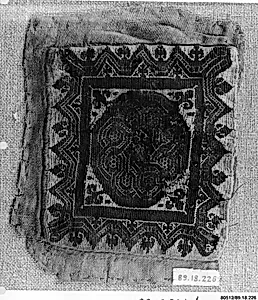
Textile Fragment
Unknown Artist
3rd–4th century
Medium
Wool, linen; plain weave, tapestry weave
Dimensions
Max. H. 4 5/16 in. (11 cm) Max. W. 3 15/16 in. (10 cm)
Classification
Textiles
Department
Islamic Art
Museum
Metropolitan Museum of Art, New York, NY
Credit
Purchase by subscription, 1889
Accession Number
89.18.226
Rights
Public Domain
Art Historical Context
This delicate textile fragment, to the 3rd–4th century, offers a glimpse into the sophisticated weaving traditions of the ancient Near East or Egypt, regions central to the early development of Islamic art. Crafted from wool and linen plain weave for the ground and tapestry weave for decorative elements, it exemplifies the technical mastery of pre-Islamic artisans. At just 4 5/16 inches high and 3 15/16 inches wide, small survivals highlight how arid climates preserved these fragile artifacts for centuries. Tapestry weave, a labor-intensive technique where colored wefts completely cover the warp, allowed for vibrant patterns and motifs—often geometric, floral, or figural—that adorned garments, hangings, and mummy wrappings. Plain weave provided a sturdy base, blending functionality with artistry. Though the artist remains unknown, this fragment reflects the cultural crossroads of Late Antique societies, influencing later Islamic textile production with its bold colors and precise execution. Acquired by the Metropolitan Museum of Art in 1889 through public subscription, it stands as a testament to enduring fascination with these everyday luxuries turned treasures. Visitors can appreciate how such textiles bridged daily life and high craft, foreshadowing the opulent fabrics of the Islamic Golden Age.