
Textile Fragment
Unknown Artist
4th century
Medium
Wool, linen; plain weave, tapestry weave
Dimensions
Max. H. 7 5/16 in. (18.5 cm) Max. W. 4 5/16 in. (11 cm)
Classification
Textiles
Department
Islamic Art
Museum
Metropolitan Museum of Art, New York, NY
Credit
Purchase by subscription, 1889
Accession Number
89.18.268
Rights
Public Domain
Tags
Art Historical Context
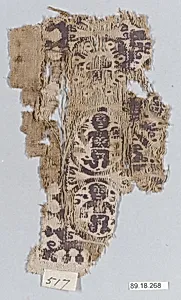
This delicate textile fragment, dating to the 4th century, a glimpse into the sophisticated weaving traditions of the late antique world, likely from the Near East or Egypt. Crafted from wool and linen using a combination of plain weave for the ground and tapestry weave for motifs, it measures just 7 5/16 by 4 5/16 inches—small enough to have adorned a garment or household item. Acquired by the Metropolitan Museum of Art in 9 through public subscription, it now resides in the Islamic Art department, highlighting the continuity of textile arts across cultural transitions. The fragment's tapestry technique, where colored weft threads create vivid patterns without floats, allowed artisans to depict human figures with remarkable detail and vibrancy. These figures, though weathered by time, suggest scenes of daily life or narrative storytelling, a hallmark of early woven arts that bridged pagan, Christian, and emerging Islamic influences. Such pieces were prized for their portability and durability, serving both practical and decorative purposes. As a survivor from over 1,600 years ago, this fragment underscores the technical mastery of anonymous weavers and the cultural richness of pre-Islamic societies in regions that later flourished under Islamic rule. It invites us to appreciate how everyday crafts preserved stories and styles across epochs.