
Textile Fragment
Unknown Artist
4th century
Medium
Wool, linen; plain weave, tapestry weave
Dimensions
Max. H. 40 3/8 in. (102.5 cm) Max. W. 2 1/16 in. (5.2 cm)
Classification
Textiles
Department
Islamic Art
Museum
Metropolitan Museum of Art, New York, NY
Credit
Purchase by subscription, 1889
Accession Number
89.18.304
Rights
Public Domain
Tags
Art Historical Context
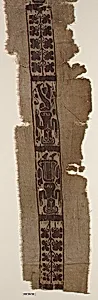
This slender textile fragment, dating to the 4th, offers a rare glimpse into the vibrant world of Late Antique weaving from the Near East or Egypt. Measuring over 40 inches long but just over 2 inches wide, likely formed part of a larger garment, curtain, or furnishing. Housed in the Metropolitan Museum of Art's of Islamic Art (purchased by subscription in 1889), it exemplifies early textiles that bridge pre-Islamic and emerging cultural traditions, featuring human figures woven into its design—a motif that highlights the era's figurative artistry before later Islamic conventions favored abstraction. Crafted from wool and linen using plain weave for the sturdy ground cloth and tapestry weave for colorful motifs, the fragment showcases sophisticated techniques. Tapestry weave, where wefts are discontinuous and packed tightly to create patterns, allowed for intricate, pictorial scenes without wasting precious yarn. This method, labor-intensive yet durable, was prized in regions like Egypt's Fayum oasis, where such textiles adorned the elite and reveal advanced dyeing and spinning skills. These fragments are cultural treasures, as organic materials rarely survive antiquity. They illuminate daily life, trade routes along the Silk Road, and artistic exchanges in a cosmopolitan Mediterranean world, inviting us to imagine the hands that wove them over 1,600 years ago.