
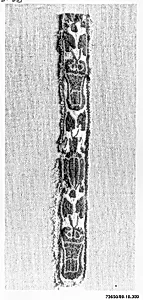
Textile Fragment
Unknown Artist
4th century
Medium
Wool, linen; tapestry weave
Dimensions
H. 9 13/16 in. (25 cm) W. 1 in. (2.6 cm)
Classification
Textiles
Department
Islamic Art
Museum
Metropolitan Museum of Art, New York, NY
Credit
Purchase by subscription, 1889
Accession Number
89.18.309
Rights
Public Domain
Art Historical Context
This delicate textile fragment, dating to the 4th, offers a rare glimpse into the sophisticated weaving traditions of the ancient Near East. Crafted wool and linen using tapestry weave—a technique where colored wefts are woven discontinuously to create intricate patterns—this narrow strip measures just 9 13/16 inches and 1 inch wide. Acquired by the Metropolitan Museum of Art through subscription purchase in 1889 it resides in the museum's Islamic Art Department, its place in the continuum of textile arts from Late Antiquity. Tapestry weave, prized for its durability and vivid color retention, was a labor-intensive method often reserved for high-status garments, furnishings, or ceremonial objects. The use of wool for warmth and linen for strength reflects practical ingenuity in a region where textiles were vital for daily life, trade, and cultural exchange along Silk Road routes. Though the artist remains unknown and the fragment's full design is incomplete, its survival underscores the artistry of early weavers whose work influenced later Islamic textile traditions. Visitors can appreciate how such humble pieces preserve stories of innovation and beauty from over 1,600 years ago.