
Textile Fragment
Unknown Artist
5th–6th century
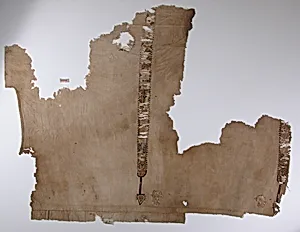
Medium
Wool, linen; plain weave, tapestry weave
Dimensions
Max. H. 2 11/16 in. (6.9 cm) Max. W. 1 7/8 in. (4.8 cm)
Classification
Textiles
Department
Islamic Art
Museum
Metropolitan Museum of Art, New York, NY
Credit
Purchase by subscription, 1889
Accession Number
89.18.319
Rights
Public Domain
Art Historical Context
This delicate *Textile Fragment* from 5th–6th century offers a glimpse into the sophisticated textile traditions of the early Islamic world. Crafted from wool and linen using plain weave for the foundation and tapestry weave for decorative patterns, it measures just 2 11/16 by 1 7/8 inches—a tiny survivor from what was likely a larger garment, furnishing, or ritual object. Acquired by the Metropolitan Museum of Art 1889 through subscription purchase, it resides in the Islamic Art department highlighting the continuity of ancient weaving practices into the dawn of Islam. The dual weaving techniques showcase remarkable skill: plain weave provided a sturdy ground cloth, while tapestry weave allowed for vibrant, discontinuous motifs inserted by hand, creating intricate designs without wasting thread. Such methods, rooted in Late Antique traditions from Egypt, Syria, or Persia, were labor-intensive and prized for their durability and beauty, often dyed with natural pigments from plants and insects. These fragments are cultural treasures, revealing daily life, trade networks, and artistic exchange across the Byzantine, Sassanian, and emerging Islamic realms. Though small, this piece underscores textiles' vital role in identity, status, and spirituality, preserving patterns that influenced centuries of Islamic design.