
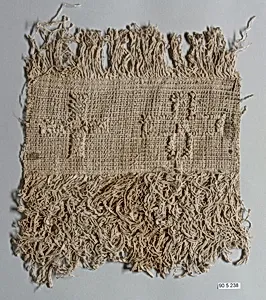
Textile Fragment
Unknown Artist
4th–5th century
Medium
Linen; plain weave, weft loop weave
Dimensions
Max. H. 8 1/4 in. (21 cm) Max. W. 6 1/2 in. (16.51 cm)
Classification
Textiles
Department
Islamic Art
Museum
Metropolitan Museum of Art, New York, NY
Credit
Gift of George F. Baker, 1890
Accession Number
90.5.238
Rights
Public Domain
Art Historical Context
This delicate textile fragment, dating to the 4th–5th centuries, offers a glimpse into the sophisticated weaving traditions of the early Islamic world. Housed in the Metropolitan Museum of Art's of Islamic Art, it measures just 8¼ by 6½ inches and was generously gifted by George F. Baker in 1890. Though created by an unknown artist, survival as a linen piece underscores the enduring value of textiles in daily life, trade, and cultural exchange across ancient Near Eastern and North African regions during late antiquity. Crafted from linen using a plain weave foundation combined with weft loop weave, the fragment showcases innovative textural techniques. Plain weave provided a sturdy, balanced structure ideal for garments or furnishings, while the weft loop weave—where extra weft threads form raised loops—added a plush, tactile dimension, possibly mimicking more luxurious pile fabrics. Such methods highlight the technical prowess of early weavers, who transformed humble flax into durable, decorative materials resilient to the region's harsh climates. As a modest survivor of time, this fragment reveals the artistry behind everyday objects in a pivotal era, bridging pre-Islamic and emerging Islamic cultures. It invites us to appreciate how textiles wove stories of craftsmanship, commerce, and community into the fabric of history.