
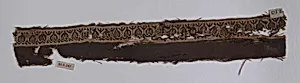
Textile Fragment
Unknown Artist
5th century
Medium
Wool, linen; plain weave, tapestry weave
Dimensions
Max. H. 14 1/16 in. (37.5 cm) Max. W. 20 1/2 in. (52 cm)
Classification
Textiles
Department
Islamic Art
Museum
Metropolitan Museum of Art, New York, NY
Credit
Gift of George F. Baker, 1890
Accession Number
90.5.247
Rights
Public Domain
Art Historical Context
This exquisite *Textile Fragment* from the 5th century offers a glimpse into the sophisticated textile traditions of the early medieval Near East or Egypt, regions central to the later development of Islamic art. Craft from wool and linen during a time of cultural exchange between Byzantine, Sasanian, and pre-Islamic societies, it survives as a modest yet precious remnant—measuring just 14 1/16 inches high by 20 1/2 inches wide—of what may have been a garment,, or wall hanging. Acquired as a gift from George F. Baker in 1890, it now graces the Metropolitan Museum of Art's Department of Islamic Art, highlighting the continuity of artistic practices across eras. The fragment showcases masterful weaving techniques: a plain weave (also called tabby) forms the sturdy ground cloth, while tapestry weave introduces colorful, discontinuous patterns by interweaving dyed yarns. This labor-intensive method, predating mechanical looms, allowed artisans to create intricate motifs with vibrant wool accents on a linen base, prized for durability and beauty in daily life and elite settings. As one of the earliest textiles in the Met's Islamic collection, it underscores the cultural importance of woven goods in ancient trade networks, from Nile Valley workshops to Silk Road routes. Such fragments reveal the anonymous skill of craftspeople whose innovations influenced centuries of Islamic textile arts, blending utility with artistry.