
Textile Fragment
Unknown Artist
5th–6th century
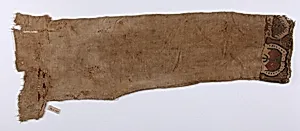
Medium
Wool, linen; plain weave, tapestry weave
Dimensions
Max. H. 18 7/8 in. (48 cm) Max. W. 8 11/16 in. (22 cm)
Classification
Textiles
Department
Islamic Art
Museum
Metropolitan Museum of Art, New York, NY
Credit
Gift of George F. Baker, 1890
Accession Number
90.5.267
Rights
Public Domain
Art Historical Context
This exquisite *Textile Fragment* from 5th–6th century offers a glimpse into the rich textile traditions of the late antique Near East, now housed in the Metropolitan Museum of Art's Department of Islamic Art. Crafted from wool and linen, measures about 19 by 9 inches (48 x 22 cm) and as a precious remnant of what was likely a larger garment, furnishing, or ceremonial object. Donated in 1890 by George. Baker, it reflects the era's vibrant trade networks spanning Egypt, Syria, and Persia, where such fabrics symbolized wealth and cultural exchange just before the rise of Islam. The fragment showcases sophisticated weaving techniques: a plain weave forms the sturdy base, while tapestry weave creates colorful, discontinuous patterns in the weft yarns. This labor-intensive method allowed artisans to depict motifs with striking precision and hue, often drawing from Byzantine, Sasanian, or Coptic influences—think geometric designs, animals, or floral elements that evoked prosperity and protection. These textiles were not mere utilities but status symbols, adorning elites and preserving stories through durable fibers suited to arid climates. Today, this fragment illuminates early Islamic precursors, highlighting how pre-Islamic craftsmanship laid the foundation for the opulent textiles of the Abbasid and later eras. A testament to anonymous mastery, it invites us to marvel at the hands that wove history into cloth.