
Textile Fragment
Unknown Artist
4th–5th century
Medium
Wool, linen; plain weave, tapestry weave
Dimensions
Max. H. 19 in. (48.3 cm) Max. W. 2 1/2 in. (6.4 cm)
Classification
Textiles
Department
Islamic Art
Museum
Metropolitan Museum of Art, New York, NY
Credit
Gift of George F. Baker, 1890
Accession Number
90.5.314
Rights
Public Domain
Art Historical Context
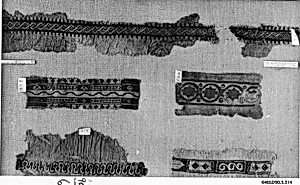
This delicate *Textile Fragment* from the th–5th century a glimpse into the sophisticated textile traditions of the Late Antique world, likely originating from the Near East or Egypt, regions central to early cultural exchanges. Housed in the Metropolitan Museum Art's Department of Islamic Art, it the artistic continuities that bridged pre-Islamic and later Islamic eras. Measuring just 19 inches high 2½ inches wide, this narrow strip—generously gifted by George F. Baker in1890—survives as a testament to everyday luxury in a time of vibrant trade along the Silk Roads. Crafted from wool and linen using plain weave for the foundation and tapestry weave for decorative elements, the fragment showcases advanced techniques that allowed for durable, colorful patterns. Tapestry weave, where weft threads completely cover the warp, was prized for its ability to create intricate motifs without relying on dyes alone, making textiles portable symbols of status and storytelling. As a rare survivor from over 1,500 years ago, this piece highlights the cultural importance of textiles in ancient societies—serving not just as clothing or furnishings but as canvases for artistic expression. Visitors can appreciate how such fragments preserve the ingenuity of anonymous artisans, connecting us to the tactile artistry of antiquity.