
Textile Fragment
Unknown Artist
3rd–4th century
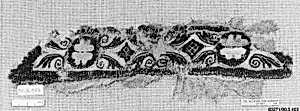
Medium
Wool, linen; tapestry weave
Dimensions
Max. H. 9 in. (22.8 cm) Max. W. 2 9/16 in. (6.5 cm)
Classification
Textiles
Department
Islamic Art
Museum
Metropolitan Museum of Art, New York, NY
Credit
Gift of George F. Baker, 1890
Accession Number
90.5.403
Rights
Public Domain
Art Historical Context
This exquisite *Textile Fragment* from the 3rd–4th century, now housed in the Metropolitan Museum Art's Department of Islamic Art, invites us into the vibrant world of Late Antique textile production. Measuring a modest 9 inches high 2½ inches wide, this surviving piece—generously gifted by George F. Baker in 1890—hints at larger garments or furnishings from regions like Egypt or the Near East, where weaving a cornerstone of daily life and trade. Woven in wool and linen using the technique, it showcases an ancient method where colorful weft threads fully cover the warp yarns, creating durable, pattern-rich fabrics ideal for clothing, curtains, or cushions. This labor-intensive process allowed weavers to produce intricate motifs with striking color contrasts, reflecting both technical skill and aesthetic sophistication during a transitional era bridging Roman, Byzantine, and early Islamic cultures. Though the artist is unknown and specific designs are fragmented, such textiles underscore the cultural prestige of weaving in antiquity. They circulated widely via trade routes, preserving stories of craftsmanship that influenced later Islamic arts, making this tiny relic a precious window into history.