
Textile Fragment
Unknown Artist
5th–6th century
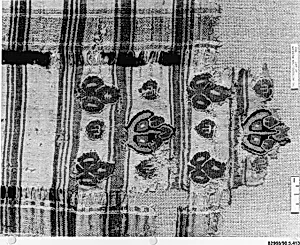
Medium
Wool, linen; plain weave, tapestry weave
Dimensions
Max. H. 18 5/16 in. (46.5 cm) Max. W. 12 1/2 in. (31.7 cm)
Classification
Textiles
Department
Islamic Art
Museum
Metropolitan Museum of Art, New York, NY
Credit
Gift of George F. Baker, 1890
Accession Number
90.5.413
Rights
Public Domain
Art Historical Context
This exquisite *Textile Fragment* from the 5th–6th century offers a rare glimpse into the sophisticated textile arts of the Late Antique world. Crafted from wool and linen using plain weave for the foundational structure and tapestry weave for elements, it measures about 18 inches high and 12 inches wide. Housed in the Metropolitan Museum Art's Islamic Art Department, this piece was generously gifted by George F. Baker in1890, highlighting its enduring value as a cultural treasure. The dual weaving techniques showcase early mastery: plain weave provided a sturdy, flexible base ideal for garments or furnishings, while tapestry weave—where colored weft threads are woven directly into the fabric—allowed for vibrant patterns without additional sewing. Such methods were labor-intensive, often produced in workshops across the Mediterranean and Near East, producing textiles that served both practical and ornamental purposes. In the context of Islamic Art, this fragment bridges pre-Islamic Late Antiquity and the emerging Islamic era, reflecting shared artistic traditions in regions like Egypt or Syria. Surviving over 1,500 years, it underscores the fragility and resilience of ancient fabrics, offering insights into daily life, trade, and craftsmanship long before the height of Islamic textile production. A testament to anonymous artisans' skill, it invites us to marvel at history woven thread by thread.