
Textile Fragment
Unknown Artist
5th century
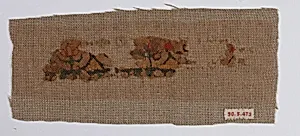
Medium
Wool, linen; plain weave, tapestry weave
Dimensions
Max. H. 6 1/8 in. (15.5 cm) Max. W. 1 3/16 in. (3 cm)
Classification
Textiles
Department
Islamic Art
Museum
Metropolitan Museum of Art, New York, NY
Credit
Gift of George F. Baker, 1890
Accession Number
90.5.473
Rights
Public Domain
Art Historical Context
This delicate *Textile Fragment* from the 5th century offers a glimpse into the sophisticated textile traditions of the early medieval Near East, housed in the Metropolitan Museum of Art's Islamic Department. Crafted from wool and linen using plain weave for the ground and tapestry weave for decoration, this tiny piece—measuring just 6 1/8 inches high and 1 3/16 inches wide— survived from a larger garment, furnishing, or ritual object. Donated in 1890 by George. Baker, it exemplifies enduring fragility and value of ancient fabrics. The dual weaving techniques highlight masterful craftsmanship: plain weave provided a sturdy base, while tapestry weave allowed for intricate, colorful motifs woven directly into the fabric, a method prized for its durability and vibrancy without relying on dyes alone. Dating to the 5th century, it bridges pre-Islamic cultures—possibly Coptic Egypt or Sassanian Persia—with the emerging Islamic world, where such textiles influenced later opulent designs in carpets, robes, and hangings. Though its exact imagery is lost to time on this fragment, it underscores textiles' cultural role as status symbols and storytelling mediums, traded along Silk Road routes. A testament to anonymous artisans' skill, it invites us to marvel at everyday artistry from 1,500 years ago.