
Textile Fragment
Unknown Artist
4th–5th century
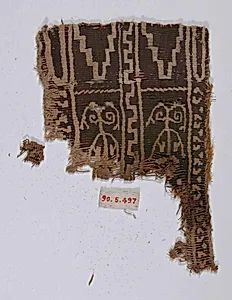
Medium
Wool, linen; tapestry weave
Dimensions
Max. H. 4 15/16 in. (12.6 cm) Max. W. 3 9/16 in. (9 cm)
Classification
Textiles
Department
Islamic Art
Museum
Metropolitan Museum of Art, New York, NY
Credit
Gift of George F. Baker, 1890
Accession Number
90.5.497
Rights
Public Domain
Art Historical Context
This delicate textile fragment, dating to the 4th–5th century, offers a glimpse into the sophisticated craftsmanship of Late Antiquity. Woven from wool and linen in a technique, it measures just under 5 inches high and 3.5 inches wide—small enough to have adorned a garment, furnishing, or ritual object. Housed in the Metropolitan Museum of Art's Art Department, it reflects the rich textile traditions of regions that would later flourish under Islamic rule, such as Egypt or the Near East. Tapestry weave, where colored weft threads are interlaced to form distinct motifs without a continuous ground, was a labor-intensive method prized for its vibrant patterns and durability. This fragment exemplifies early mastery of the technique, likely used to depict symbolic designs that held cultural or spiritual meaning in daily life or funerary contexts. As a gift from George F. Baker in 1890, this piece underscores the enduring allure of ancient textiles, bridging pre-Islamic artistry with the broader narrative of Islamic cultural heritage. Though details of its imagery are not specified, its survival highlights how such fragile works preserve stories of ancient innovation and beauty.