
Textile Fragment
Unknown Artist
7th–8th century
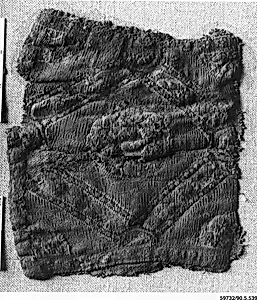
Medium
Wool, linen; tapestry weave
Dimensions
Max. H. 7 11/16 in. (19.5 cm) Max. W. 6 1/2 in. (16.5 cm)
Classification
Textiles
Department
Islamic Art
Museum
Metropolitan Museum of Art, New York, NY
Credit
Gift of George F. Baker, 1890
Accession Number
90.5.539
Rights
Public Domain
Art Historical Context
This delicate Textile Fragment, dating to the 7th–8th century, hails from the early Islamic world and showcases the artistry of an unknown weaver. Crafted from wool and linen in a weave technique, it measures just 7 11/16 by 6 1/2 (19.5 by 16.5 cm). Now housed in the Metropolitan Museum Art's Department of Islamic Art, it was generously gifted by George F. Baker in1890. Tapestry weave, where colored weft threads are woven discontinuously to form patterns, was a sophisticated method prized for its vibrant designs and durability. In the early Islamic period—spanning the Umayyad and early Abbasid eras—this technique flourished in regions like Egypt and the Levant, producing textiles for clothing, furnishings, and trade goods. Though only a fragment survives, it exemplifies the high level of technical skill and material innovation that defined Islamic textile production. These rare survivors offer invaluable insights into the cultural and economic vibrancy of the time, when textiles served as symbols of status and artistry. Visitors can appreciate how such pieces bridged pre-Islamic traditions with the emerging Islamic aesthetic, highlighting a golden age of craftsmanship.