
Textile Fragment
Unknown Artist
5th–6th century
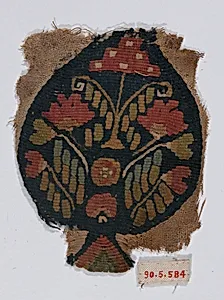
Medium
Wool, linen; plain weave, tapestry weave
Dimensions
Max. H. 3 3/4 in. (9.5 cm) Max. W. 2 13/16 in. (7.1 cm)
Classification
Textiles
Department
Islamic Art
Museum
Metropolitan Museum of Art, New York, NY
Credit
Gift of George F. Baker, 1890
Accession Number
90.5.584
Rights
Public Domain
Art Historical Context
This delicate textile fragment, dating to the 5th–6th century, offers a glimpse into the sophisticated weaving traditions of the early Islamic world—or its cultural predecessors in the Near East. Housed in the Metropolitan Museum of Art's of Islamic Art, this tiny piece (just 3 3/4 by 2 13/16 inches) survives as a testament to everyday artistry from a time of vibrant trade and cultural exchange along ancient Silk Road routes. Likely part of a larger garment, curtain, or furnishing, it was generously donated by George F. Baker in 1890, preserving a fragile link to antiquity. Crafted from wool and linen using plain weave for the foundation and tapestry weave for decorative patterns, the fragment showcases advanced techniques that allowed weavers to create bold, pictorial designs without complex looms. Tapestry weave, where colored wefts completely cover the warp, produced durable, vibrant motifs ideal for both practical use and symbolic expression—think geometric patterns or figures evoking protection, fertility, or status. Though the artist remains unknown, such textiles highlight the unsung mastery of ancient craftspeople, whose innovations influenced centuries of Islamic textile production. Visitors, imagine wrapping yourself in this resilient fabric, a survivor of time that whispers stories of distant markets and skilled hands.