
Textile Fragment
Unknown Artist
5th–6th century
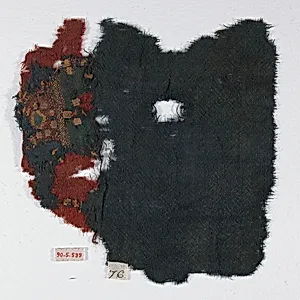
Medium
Wool, linen; plain weave, tapestry weave
Dimensions
Max. H. 7 5/16 in. (18.5 cm) Max. W. 6 15/16 in. (17.7 cm)
Classification
Textiles
Department
Islamic Art
Museum
Metropolitan Museum of Art, New York, NY
Credit
Gift of George F. Baker, 1890
Accession Number
90.5.599
Rights
Public Domain
Art Historical Context
This delicate Textile Fragment, dating to the 5–6th century, a glimpse into the sophisticated textile traditions of the late antique world, preserved in the Metropolitan Museum of Art's Department of Islamic Art. Craft from wool and linen using plain weave and tapestry techniques, it measures just 7 5/16 by 6 15/16 inches, suggesting it is a surviving piece from a larger garment, furnishing, or ceremonial object. Such fragments highlight the era's vibrant trade networks across the Mediterranean and Near East, where textiles served as symbols of wealth, identity, and cultural exchange. The combination of plain weave for the ground fabric and tapestry weave for decorative elements demonstrates masterful craftsmanship. Tapestry weave, in which weft threads are discontinuous and packed tightly to form patterns, allowed artisans to create intricate motifs without wasting precious yarn—a technique that persisted into early Islamic art. Though the artist remains unknown, this fragment underscores the anonymous yet highly skilled labor of ancient weavers, whose work bridged Byzantine, Sasanian, and pre-Islamic traditions. A generous gift from George F. Baker in 1890, this artifact invites us to appreciate the fragility of history: small in scale but immense in storytelling, it connects us to daily life in a transformative period.