
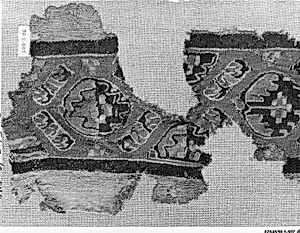
Textile Fragment
Unknown Artist
5th–6th century
Medium
Wool, linen; plain weave, tapestry weave
Dimensions
Max. H. 12 3/16 in. (31 cm) Max. W. 4 1/8 in. (10.4 cm)
Classification
Textiles
Department
Islamic Art
Museum
Metropolitan Museum of Art, New York, NY
Credit
Gift of George F. Baker, 1890
Accession Number
90.5.607
Rights
Public Domain
Art Historical Context
This delicate textile fragment, dating to the 5th–6th century, offers a glimpse into the sophisticated weaving traditions of Late Antiquity in the Islamic world. Housed in the Metropolitan Museum of Art's Department Islamic Art, it measures just 12 3/16 inches high 4 1/8 inches wide, likely a surviving piece from a larger garment, curtain, or furnishing. Crafted by an unknown artist using wool and linen, it early textile production in regions like Egypt or the Near East, where such were essential for daily life and trade. The fragment combines plain—a simple, durable tabby structure ideal for foundational cloth—with tapestry weave, a labor-intensive technique where colored wefts create pictorial or geometric patterns without floats. This dual method highlights the technical prowess of ancient weavers, blending functionality with decorative flair. Tapestry weaves, in particular, allowed for vibrant, durable motifs that influenced later Islamic textiles. A generous gift from George F. Baker in 1890, this fragment preserves the artistry of a transitional era, bridging pre-Islamic and early Islamic cultures. Though small, it reveals the enduring cultural importance of textiles as carriers of pattern, color, and skill in the ancient world.